
The In-between
On finding yourself in books when the old story no longer works and the new one cannot yet be told.

It’s strange what happens once you’ve become aware of something new. How a thought, an experience or a question that had only existed as a vague feeling suddenly takes shape. It stands there in full view, impossible to ignore. You start seeing it everywhere. In books you’ve already read. In films, conversations, people. In stories that may have been there all along but that you somehow didn’t yet have the inner language to truly hear.
Ever since I began exploring and writing about the space you enter when you’ve left something behind but haven’t yet fully stepped into whatever comes next, I’ve been seeing it everywhere.
My mind seems to organize reality differently now, and I’m beginning to wonder whether it’s not only the way I live that’s changing. Maybe it’s also the way I understand myself. Or rather, the story I use to make sense of my life.
My routines no longer hold my days together the way they used to. Ambitions that once drove me have lost their direction. Places that used to define me no longer feel like home, while others are beginning to pull me in without me really knowing why.
My rhythms are changing too. A new one has quietly emerged. I wake at dawn with thoughts that want to be written. My body wants to stay in bed. The rest of the family is asleep. I should probably be asleep too. But I listen instead. I read, then pour out words, back and forth between the two. Sometimes I fall asleep again.
It’s as if my entire inner operating system is being dismantled. Every supporting wall. Every piece of furniture. None of the words I’ve learned to describe myself with, the ones tied to my profession or identity, can really explain what’s happening. This goes much deeper than that.
On the days I feel strong, the movement feels completely natural. But on the days I doubt myself, I borrow the old worldview again. I see myself through the eyes of people who’ve known me for years, wondering what happened, where I disappeared to, and what strange, fluffy things I’m doing now.
For a moment, I see myself through their story. And in that story, I look a bit crazy.
That’s why texts that remind me there are other ways of understanding what it means to be human have become so important. That what I’m experiencing isn’t necessarily a sign that I’ve lost my way, but perhaps that the old map no longer describes the landscape I’m living in.
There’s comfort in reading and realizing I’m not nearly as unusual as I sometimes feel. That others, in other times, have tried to describe the same strange experience. That there are stories of dissolution that aren’t about collapse but about reorganization. That there are languages that describe the in-between as a necessary part of becoming.
It gives me the courage to stay in that space a little longer. To keep searching until what now feels unfamiliar becomes self-evident.
The Story
What stories do we actually tell about what it means to be human?
From an early age we’re taught that a life should be told in a certain way. That it should have direction. An identity. A main character who slowly becomes more fully themselves.
We’re supposed to choose a path. Find ourselves. Make something of ourselves. Become someone. And then we’re expected to hold on to that story. To be consistent. Coherent. Understandable, both to ourselves and to others.
We introduce ourselves with nouns. I’m an entrepreneur. I’m a doctor. I’m a carpenter. I’m a parent. As though those words explain who we are.
Sometimes we replace one noun with another, as if the answer were simply to find a label that fits better. But the story itself doesn’t change. It still assumes that life moves forward in a clear direction, that each step can be explained by the one before it, and that the main character remains stable throughout.
Maybe that’s why change feels so much like death. The story stops working. We no longer know how to describe ourselves. How to make sense of ourselves, to others or even to ourselves.
Someone asks what I do. I begin to answer and realize the sentence never quite ends. None of the words fit anymore. What I’m describing is an older version of someone who no longer exists.
And it’s not only that I haven’t found the right story. It’s the shape of the story itself. It assumes a fixed centre. A self that owns its history, chooses its direction, and remains recognisable over time. But that’s a fairly modern idea of what a human being is. And probably not the whole truth.
It gives the in-between a different meaning. It’s not an empty space left behind by a lost self. It may be the place where something other than the self is able to emerge.
We have almost no language for that experience. We have words for success and failure, career changes and life crises. But very few words for the place where the old order no longer works and the new one cannot yet be told.
Which is why the in-between so easily becomes a problem to solve. We try to fill it. Explain it. Optimise it as much as our relationships, our time, or our finances allow. We try to get through it as quickly as possible.
Rarely do we ask whether the in-between is a place in its own right. An essential part of how a life changes, with its own rhythm, its own language, and a kind of knowledge that cannot always be understood.
Circe
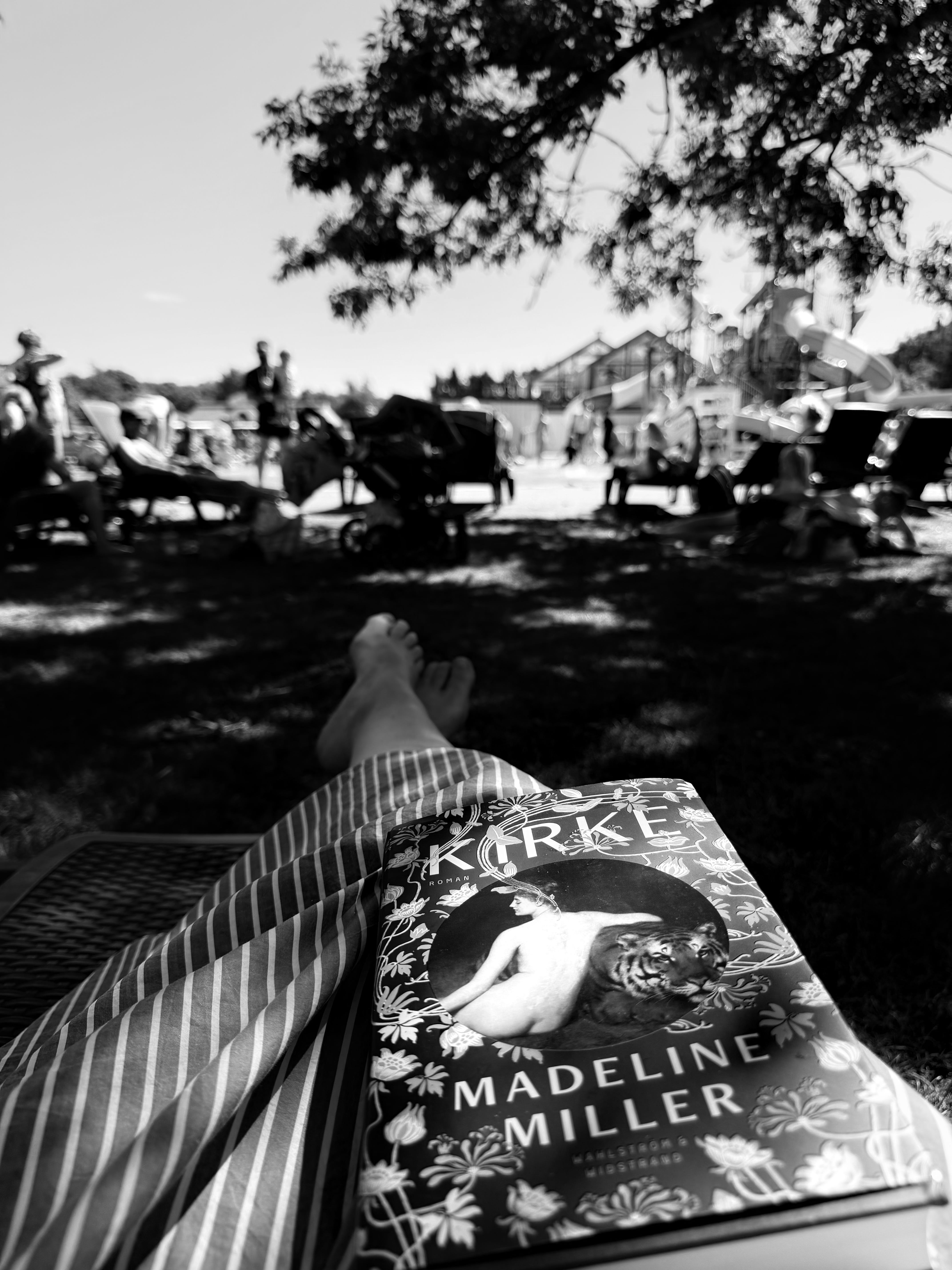
Trying to listen more closely to my inner compass, my intuition and instincts, rather than the rational structure of what I think I should do, has also meant giving up the idea that books need to be read in order or for any particular purpose. Instead, I find myself opening the ones that, for reasons I can’t explain, keep asking for my attention. Madeline Miller’s Circe was one of them.
A friend of mine was so inspired by Circe that she wrote an album. I heard her, but I didn’t really listen at first. Then I found the book in my father’s bookshelf after he died, unread and slightly faded by the sun, as if it had been waiting for me.
I thought I was about to read a novel about a Greek goddess. Instead, it quietly crept under my skin from the very first sentence, and I began to glimpse entirely new ways of understanding what it means to be human.
Now I wonder if I’ve been reading Greek mythology the wrong way all along. Thinking of the gods as characters, when perhaps they can be read as a forgotten language for the inner life. Something deeply alive rather than something to study. Forces moving through us.
Love. Struggle. Wisdom. Desire. Play. Memory. Intoxication.
Seen that way, the change I’m going through becomes something else entirely. I no longer have to think that I’m becoming someone different. I only need to make room for something that has spent far too long in the background.
We already do this all the time. We are one person with our parents, another with our friends, and someone else again when we’re alone. Different parts of us come forward in different situations, yet we keep talking about ourselves as though there were one stable self beneath it all, simply waiting to be discovered.
Somewhere deep down I suspect that this stable self is a very modern idea. Perhaps human beings have always been more like weather. Warmth and cold. Winds moving through us, gathering strength or fading away as something else quietly takes their place.
I don’t know if that’s true. Perhaps it’s only one way of reading it. But right now, I’m much less interested in understanding the book, or even what its author intended, than I am in understanding myself.
Circe gives me a map. A way of seeing that this in-between is neither a failure nor the end of the story. A map that allows me, at least for a while, to stop looking for the person I ought to be and instead become curious about the one who is still coming into being.
This is becoming a book - and I need you to make it real. If any of this resonates, please consider pre-ordering. Your support doesn’t just fund a book - it signals that these perspectives matters.
And for practicing all of this together with me you can join the 100 days process.
💛🌻💛
Dear Anna, as you describe this liminal space it strikes a true chord in me and I'm sure others. The space is always uncomfortable but given the time, the moves you make, and the comforting rituals and friendships that exist are very helpful during such times. Thank you for sharing this, Barry