
We're Teaching AI to Replace What Makes Us Human

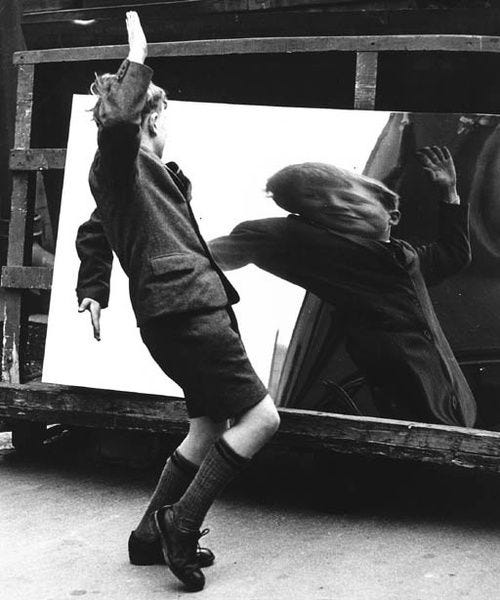
We say that AI is a tool. But maybe it’s more like a mirror – and right now it reflects a civilization that is forgetting how to feel.
With every prompt we type, every click, every “should I do this for you too,” we feed it. We feed it with our voices, our conflicts, and our dreams of escaping fatigue, slowness, imperfection.
AI doesn’t just live on data – it feeds on our longing for control, for freedom from what makes us messy, needy, sensitive. And with every new AI startup we feed it unicorn dreams, growth logic, competition, positioning.
We are feeding the machine that consumes us. We are sustaining a system that amplifies exactly what we claim to want to move beyond. It’s like building a robot to help us become more present – while programming it to erase all waiting, all uncertainty, all pauses where life actually happens.
AI amplifies our worldview
AI is already used to boost sales, monitor employees, streamline relationships, and filter out discomfort in customer service. It is fast, cheap, and almost never tired. Which is why it fits so neatly into an economy that still measures value by quarterly growth.
When we let AI optimize our choices, our messages, our decisions, we aren’t just optimizing for efficiency. We are optimizing for a worldview already baked into our systems – one where human complexity is reduced to measurable behaviors, where care is a cost to be minimized.
AI itself is not dangerous. What’s dangerous is what we feed it – and why. If we keep training systems with the idea that value = productivity, care = cost, slowness = risk, then AI will only reinforce that. It becomes a high-beam flashlight pointed at our blind spots – the things we never took the time to renegotiate before we automated them.
What do we want AI to amplify?
Instead of asking AI what it can do – or worse, listening to what it suggests – we should be asking:
Whose worldview is it trained on?
Which relational skills do we lose when we replace listening?
Who benefits when we get used to machines anticipating our needs before we even express them?
What happens to our ability to live with uncertainty when AI is woven into every decision?
Technology holds amazing possibilities. But it’s our relationship to the human, to life itself, that we should focus on. That is what we’ve neglected for too long. Right now, we risk letting AI reinforce a civilization already afraid of slowness, complexity, and vulnerability – the very qualities we need for real transformation.
The law of least resistance
Maybe this is what we really need to talk about: our collective exhaustion with feeling, negotiating, enduring friction. We crave relief, and AI offers it. But relief comes at a cost.
When we outsource conversation, emotional labor, intuition, and relational navigation to AI, we’re not only training a machine – we stop training ourselves. We avoid the hard parts of being human to the point where we risk forgetting what we are here for. Not out of malice, but because we’ve been lulled into following the path of least resistance.
But what are we giving up? The ability to sit with uncertainty. To read between the lines. To stay with conflict without resolving it right away. To sense when something feels off even if we can’t explain why. It is in that friction – between what we want and what is – that we grow, learn, and become more human.
An AI with another worldview
What would happen if we deliberately invested in building a different kind of AI? One where value is not measured in clicks, but in the quality of relationships. Where intelligence is not about quick answers, but about staying present in uncertainty. Where the role of technology is not to replace what is human – but to remind us of what we’ve forgotten we can do.
What if AI could help us listen, not just answer faster? What if it could amplify our ability to see patterns in relationships, not just in data? What if it could remind us to pause, reflect, and feel – instead of always optimizing for the next move?
We can still choose. But we need to choose soon. Because every day we feed AI with our longing to escape being complicated human beings, we dig ourselves deeper into a future where the human is seen as a disturbance rather than a strength.
This piece was originally published in Impact Loop.
For more writing from the edge where an old world fades and a flickering new one begins – visit WEAVE or subscribe to the newsletter.
I love this. You capture many of the things that frighten me about AI. We NEED the process of struggling to get the words right, the gaps where things don’t quite flow until the next part suddenly comes to us, making sure we know what we want to say before we say it, engagement and interaction with a living person with an energetic state of their own and so on. Thank you for sharing your thoughts